For 20 Years I Carried Nail Scissors in My Makeup Bag. I Just Couldn’t Tell Anyone What They Were For.
They were for my compression socks — the “wide-calf” ones that never actually fit. This is the story of forty-one pairs cut open on my kitchen table, two phone calls to a sock factory, and the sentence that finally took the blame off my legs — after twenty years of believing it was me.
There is a pair of nail scissors in my makeup bag that I carried for twenty years, and until recently I could not have told you what they were for without lying.
They were for my socks.
Every “wide-calf” compression sock I ever owned stopped dead at the widest part of my calf.
So I’d snip the top band — just enough to drag it over — which ruins the compression, which is the entire reason the sock exists.
I knew that.
I did it anyway.
Quietly.
With the bathroom door locked, so my husband wouldn’t see the fight.
You do a lot of things quietly, behind a locked door, once you’ve decided your body is the problem.
I want to tell you what finally un-decided it for me.
It wasn’t a doctor, and it wasn’t a product, and it certainly wasn’t self-love, whatever that costs these days.
It was a tired man at a sock factory who told me, in one sentence, that the exam I’d been failing for twenty years was graded before I was born.
But first I have to tell you about my daughter’s wedding.
Because that’s the morning I stopped being polite about all of this.
The Morning of Katie’s Wedding
It was 6:40 in the morning, in a hotel room, on the biggest day of my daughter’s life, and I was sitting on the edge of the bed in my slip, crying hard enough to ruin makeup I hadn’t put on yet.
I knew I’d be on my feet for twelve hours.
My legs swell when I stand — they have since my forties — so weeks earlier I’d ordered the good socks.
The “extra-wide” ones.
The package said made for fuller calves, and I believed it the way you believe a thing that has already burned you nine times.
Which is to say: desperately.
I got one leg up on the bed, hooked both thumbs into the band, and pulled.
It stopped at the widest part of my calf.
Dead.
It would not go over.
Hotel bathroom.
Nail scissors.
Snip.
By the reception my ankles had swallowed my shoes, and there were two purple grooves behind my knees so deep they looked like wire marks.
And when the band started up and Katie came across that floor with her hand out — asking her mother to dance — I said, “My feet hurt, sweetheart. You go on.”
She danced with her aunt.
I sat with my legs under the tablecloth and clapped.
I lied at my own daughter’s wedding so nobody would see me limp.
And something in me went cold and quiet that night, and it stayed cold the whole drive home.
The Verdict I Carried for Twenty Years
Here’s the part that’s harder to admit than the scissors.
Somewhere in those twenty years — two sizes, four brands, one drawer I eventually stopped opening — I had reached a verdict.
And the verdict was me.
Too big. Hard to fit. Let myself go.
I learned it from a size chart that didn’t have my number on it.
I learned it from a 22-year-old at a store counter who looked at my legs and said, “those might run a little small,” with a smile I still think about.
I stood in a fitting room outside Columbus once and thought, in these exact words: what is wrong with me?
Not with the sock.
With me.
The verdict gets into everything.
I’ll prove it.
My doctor prescribed compression when the swelling started.
I told him I wore my socks every day.
The truth is I wore them to his appointments.
I could not get them on alone, and I would rather lie to a man with a stethoscope than say that sentence out loud.
I paid a tailor to alter a compression sock once.
She was kind about it.
It fit nobody afterward.
I have never told anyone that until right now.
I once threw a sock across the bedroom and broke the little lamp on the dresser.
A sock.
It weighs nothing.
You have to be very specifically angry to hurt furniture with a sock.
And the one I’m least proud of: I stood behind Katie at her final dress fitting — my girl, my joy, the best thing I ever made — and caught myself staring at her slim ankles, doing quiet arithmetic about whose side of the family they came from.
That’s what twenty years of this does.
It doesn’t stay on your calves.
It gets into the fitting room, the doctor’s office, the wedding, even the good days.
So when I got home from that wedding, I didn’t buy another pair.
I pulled every sock I owned out of the drawer, dumped them on the kitchen table, and started asking a different question.
Not what’s wrong with my legs.
What’s wrong with these socks?
Forty-One Pairs and Two Phone Calls
I’ll be honest: I went a little crazy.
I ordered every “wide,” “extra-wide,” and “plus” compression sock sold in America, near as I could tell.
Forty-one pairs.
I counted, because counting felt like doing something.
They lived in a laundry basket by the table, and at night, after my husband went to bed, I cut them open with sewing scissors to look at the knit — and pair after pair, the strangest thing.
Inside, they were the same sock.
The “wide” one and the regular one.
Same tube, same taper, same everything, like twins in different jackets.
I read hosiery patents until two in the morning.
I learned words like circular knit and cylinder count.
My husband started referring to “the sock situation” in the tone you’d use for a gambling problem.
And then I did the only smart thing in this whole story.
I stopped reading and called the factories.
The first call was polite and useless — a young man reading loyalty to a script.
The second call, I got an older gentleman who’d been knitting socks for thirty-four years, and when I asked him why “wide-calf” socks never fit a wide calf, he didn’t get defensive.
He laughed.
Tiredly.
The way you laugh when someone finally asks the question you’ve been waiting thirty years to answer.
“Ma’am,” he said, “most ‘wide calf’ socks are the same tube as the regular ones. Same machine. Same template. They print the word WIDE on the bag, because re-tooling a knitting machine costs real money, and printing a new word costs nothing.”
And then the sentence.
The one I’d drive to your house and repeat if I could.
“One size fits most means most of the socks we already know how to make. Not most of the women.”
Not most of the women.
I thanked him.
I hung up.
And I sat at my kitchen table with forty-one pairs of evidence in a laundry basket and did the arithmetic on twenty years of mornings — the locked doors, the scissors, the lie to my doctor, the verdict.
There was never a fitting test.
The answer was printed on the bag before I ever pulled it over my heel.
It Was Never Your Legs
Now let me hand you what he handed me, because it’s yours too.
A compression sock is a straight tube, knit to hug a calf the industry decided is “average” — about fifteen inches around.
And the idea itself is genuinely good: firmest at the ankle, easing as it climbs, a gentle push uphill all day so your legs feel lighter by dinner.
When the tube matches the leg, it feels like a hand on your shoulder.
But when your calf sits an inch or two past their template, that same tube has to stretch further than it was ever engineered to — and it spends the entire day fighting to snap back to a shape that isn’t yours.
At the top, the fight becomes a tourniquet.
That’s the ring.
In the middle, the hug becomes a squeeze, then a strangle.
And it rolls, because rolled-down at your ankle is the only place that fabric finally gets to relax.
It digs.
It rolls.
It leaves the ring like a receipt.
And then they sell you a bigger number of the exact same tube — and you go home and read the receipt as a verdict about your body.
Hear the difference.
The sock wasn’t failing to fit you.
You were being fitted to the sock — and billed for the difference in scissors, in long pants in July, in dances you sat out.
A carpenter doesn’t cry when a size-nine glove won’t go over a size-eleven hand.
He doesn’t stand in the garage wondering what’s wrong with him.
He gets the right glove, and he never thinks about it again.
Twenty years, and nobody ever offered me the right glove.
What a Sock Owes You
Once you understand the machine, you can write the standard yourself.
For a compression sock to work on a real calf — not an “average” one — it has to do three things at the same time:
Fit the width
Knit wide from the first stitch — built around real calves like ours, not a 15-inch “average” with a new word printed on the bag.
Hold without biting
A wide, flat top band that spreads its grip across the whole calf, so it stays up all day without carving a line into you.
Go on easy & breathe
Stretch enough to slide on in one pull, in a knit that doesn’t cook your legs by noon.
Miss one, and you’re back at the drawer.
The drugstore pair fits the width, maybe — but it bites and rolls.
The “firm support” pair holds — but you need two hands, a doorframe, and a ten-minute head start.
The pretty bamboo pair feels lovely for an hour and lives at your ankle by lunch.
All three.
At once.
Or it doesn’t count.
I took that standard to the mills, and here is where I’m supposed to tell you a heroic story about American manufacturing.
The truth is shorter: most of them said no.
Re-tooling is expensive, remember — that’s the whole scam.
But a small family mill said yes, and re-set the actual needles: a genuinely wider body, a soft flat band, a breathable blend, graduated compression starting at the ankle the way the textbooks always said it should.
So — and I still can’t quite believe I get to write this sentence — the sock I couldn’t find for twenty years, I made.
My Sister, on a Kitchen Chair
The first person to try a pair was my sister Dawn, whose calves are bigger than mine, and who had quietly given up on anything with elastic somewhere around 2019.
She didn’t announce it.
Women like us never announce it.
One day there are just no more socks, and long pants, and a way of sitting with your legs tucked back under the chair.
She sat on my kitchen chair.
She slid it on in one pull — no fight, no scissors — and then she just stopped, hands still on the cuff, and looked up at me with her eyes full.
“Maggie. It doesn’t hurt.”
That’s the whole review.
Four words.
A grown woman, startled that a sock could go on, stay up, and feel like a hug instead of a punishment.
We sat at that table for an hour afterward, and she told me her locked-door stories, and I told her mine, and we laughed until we didn’t.
Twenty years, the two of us, half a mile apart, each hiding the same fight from the other.
That’s the part I can’t forgive the bag-printers for.
Not the rings.
The hiding.
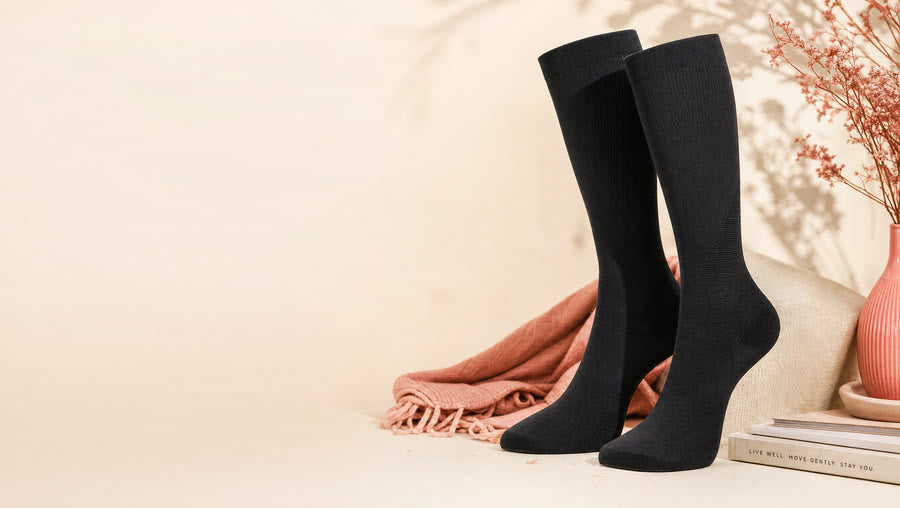
We named it Huggley, because that’s the entire idea — a hug, not a vice.
And notice that this is the first time the name appears in this article.
That’s on purpose.
The sock was never the point.
The verdict was the point.
Your First Morning
I can tell you exactly how your first morning will go, because I’ve heard it retold thousands of times now, and it’s always the same small scene.
You’ll sit on the edge of the bed braced for the fight, because twenty years of mornings taught you to brace.
The opening will clear the widest part of your calf in one motion — and your hands will keep waiting for a struggle that doesn’t come.
It’s a strange feeling, an argument you got dressed for that never shows up.
At the ankle you’ll feel a firm, friendly squeeze.
The good kind.
It eases as it climbs.
The band at the top lies flat and simply stays.
Then you’ll stand up, walk to the kitchen, and somewhere around the coffee maker you’ll realize you’ve stopped thinking about your socks.
If you’re one of us, that may be the first time that’s happened in a decade.
And at night, when you peel them off, look down.
Just your leg. No ring. No groove. No receipt.
My sister cried on a kitchen chair.
A retired nurse in Fort Worth told us she stood in her bathroom and laughed at her own leg.
You’ll do your own version, and it will be small, and it’s supposed to be small.
The big thing it undoes was built out of small mornings too.
400,000 Women Later
What 400,000 wide-calf women told us after switching from “one-size” compression socks
The pattern was overwhelming: when the sock is knit for real calves — not an “average” template — women report it goes on easier, stays up without rolling, and leaves no ring at the end of the day.
Since that first kitchen batch, more than 400,000 women have made the switch.
When we ask how it’s going, here’s what comes back:
“I have 18-inch calves and I have CRIED in fitting rooms. These went on with one hand. I actually gasped. My husband came running because he thought I fell.”
“I’m a retired nurse. I know compression. I did NOT know it could feel like this. No ring behind my knee for the first time in 30 years.”
“I wore them on a 6-hour flight and my ankles were still my ankles when I landed. Do you know what that’s like at my age? I nearly wept in baggage claim.”
Every one of those women had a drawer, and a locked door, and a verdict.
Just like maybe you do.
The Drawer Math
Before we talk about price, open your sock drawer in your mind and count with me.
The $12 drugstore pair that dug in.
The $28 “extra-wide” pair from the ad that stopped dead at the widest part of your calf, exactly like mine did.
The $40 “medical” pair, stiff as a splint, that needed two hands and a prayer.
The pair the tailor altered.
The pairs in the back you keep because throwing them out feels like admitting something.
Most of us have spent hundreds of dollars over the years learning the same wrong lesson: that the failure was ours.
Huggley costs what a good, honest pair of everyday socks should cost.
I built it for my sister and for me — and, it turns out, for four hundred thousand women I’d never met who were all hiding the same fight behind the same doors.
And because nobody with legs like ours wears one pair — you need them for the good days and the swollen days, the wash and the wear, the drawer and the suitcase — the pricing does the only honest thing pricing can do: the more pairs you buy, the less each pair costs, with the math printed right on the page.
Two pairs saves a little.
Three or more saves the most, and that’s where most women land.
No coupons.
No games.
No Tuesday-only nonsense.
The Catch (We Knit Small)
There is one catch, and I’d rather tell you plainly.
To keep the fit true, we knit in small runs — and they sell out, because it turns out there are far more of us than the industry ever admitted.
When a run is gone, it can be weeks before the machines come back around.
I won’t put a fake countdown clock on this page.
I’ll just say this: every morning we’re out of your size is another morning some woman is sitting on the edge of her bed with nail scissors, behind a locked door, doing arithmetic against her own body.
If your size is in stock today, that’s not nothing.
Try Huggley On →See prices & what’s in stockTry Them on Your Own Leg
You’ve been burned.
You have a drawer of proof.
So I’m not going to ask you to trust me.
And I’m not going to hand you a size chart, either.
There isn’t one.
That was the point.
We started the knit at a wide calf and gave it stretch that goes far past mine — so instead of your leg having to qualify for the sock, the sock comes ready for your leg.
No numbers.
No charts.
You’ve been measured enough.
So here’s the only test left, and it happens in your own bedroom, on your own leg, with nobody watching.
If they don’t slide on easier than anything you own… if the band leaves a single mark… if any part of them feels like vice instead of hug… send them back and we’ll refund you.
No lecture.
No forms maze.
No restocking fee.
I can offer that because I already know what happens when a woman with a real calf puts these on.
She doesn’t send them back.
She orders three more and calls her sister.
I know.
I was the sister she called.
Two Kinds of Tomorrow
Tomorrow morning is coming either way.
There are two ways to meet it.
One is the way you’ve been meeting it: braced on the edge of the bed, thumbs hooked, breath held, scissors within reach, long pants in July, and the ring waiting at the end of every day like a bill you never agreed to.
The other is a sock that goes on in one pull and disappears from your thoughts until you take it off — and there’s nothing on your skin to show for the day but the day.
I picked mine four years ago.
The nail scissors are still in my makeup bag, by the way.
They haven’t worked in four years.
I like seeing them there.
Retired.
Here’s All You Do
- Tap the button below and pick your pack — one to try, or three so there’s a pair for every part of your life (and the best per-pair price).
- That’s the whole order form. No tape measure. No size chart. One fit, knit wide from the first stitch.
- When they arrive, try them in your own bedroom, on your own leg, with zero pressure — every order carries the 60-night try-on promise.
- If they leave so much as a ring, send them back and we refund you.
- Then do the thing I couldn’t do at Katie’s wedding. Stand up.
With love, from one wide-calf woman to another,
Maggie Sutton
Founder, Huggley
P.S. — My youngest, Emily, got married this past June.
Different wedding, same mother.
When the band started playing, I stood up in my Huggleys and danced with my daughter until my feet hurt for the right reason.
Nobody at that reception knew they were watching a woman settle a twenty-year score with a sock.
But that’s what it was.
P.P.S. — There is no size chart waiting to fail you this time.
One fit, knit wide on purpose, with stretch to spare — and a 60-night promise doing the job the charts never could.
The only test left happens in your own bedroom, and you can’t fail it.
P.P.P.S. — We knit in small runs to keep the fit honest, and the runs go fast.
It turns out there are a lot more of us than the sock industry ever wanted to admit.
If your size is in stock today, don’t wait for the drawer to win again.
Try Huggley On →UPDATE: demand has been climbing fast, and small-run stock moves quickly. One fit, knit wide from the first stitch — no size chart, no measuring. Lock yours in while this run lasts.
Every order is backed by the 60-Night Try-On Promise. Slide them on your own leg — if they leave a ring, send them back.
Comments